Overview
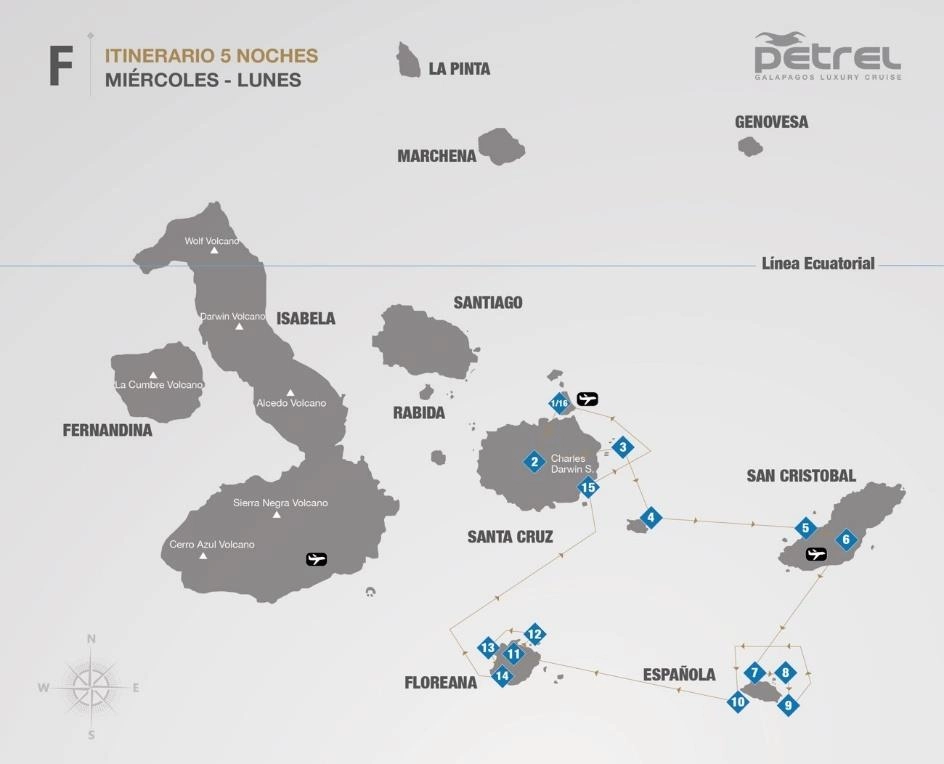
ITINERARY DAY BY DAY
B: breakfast / L: lunch / D: dinner)
1.-WEDNESDAY- Arrival at Baltra Island
2.-THURSDAY – Isla Plazas Sur
3.-FRIDAY – Isla Lobos – San Cristóbal Island – David Rodríguez Giant Tortoise Breeding Center
4.-SATURDAY – Española Island – Gardner Bay / Osborn Islet / Gardner Islet – Punta Suarez
5. -SUNDAY – Floreana Island – Devil’s Crown / Cormorant Point – Post Office Bay / Baroness’s Lookout
7.-MONDAY – Santa Cruz Island – Charles Darwin Research Station Today – Transfer Out to Baltra Airport
Itineraries are subject to change without prior notice due to weather conditions, regulations of the National Park, onboard emergencies, or any unforeseen situations.
| ITINERARY F – 5nights – Wednesday/Monday | Double (p/p) |
| Golden State Rooms | USD$ 6.190 |
Itinerary
Day 1 :
WEDNESDAY
AM: Arrival at Baltra Island. A Petrel representative will welcome you after immigration and baggage claim. Afterward, you'll be transferred to the cruise ship and shown to your cabin. There will be time to settle in before the welcome meeting and lunch.
PM: Santa Cruz Island - Highlands. Explore the Highlands of Santa Cruz to visit the Twin Craters, collapsed magma chambers of a volcano. After years of erosion, the once-filled chambers collapsed, leaving two similar craters that can be seen on a short hike through a Scalesia forest.
Get ready to admire the famous giant tortoises in their natural habitat, an awe-inspiring sight as these endemic animals give the Galapagos archipelago its name. Birdwatching is also a highlight in the Highlands, as the area is home to finches and other Galapagos birds. Finally, you'll walk through lava tunnels to witness the massive magma flows that shaped the islands before returning to the M/C Petrel.
(B, L, D)
Day 2 :
THURSDAY
AM: Isla Plazas Sur
Plazas Sur, one of the smallest visitor sites, hosts an incredibly diverse array of flora and fauna. It boasts a large population of Sesuvium plants, including the prickly pear cactus, a crucial food source for land iguanas. The eradication of mice from the island some years ago helped the land iguana population thrive once again.
PM: Santa Fe Island is home to the Santa Fe land iguana and the exclusive Opuntia cactus. While giant tortoises were once native to this island, they were depleted by pirates and buccaneers who used them as food onboard their ships. The island is also known as Isla Barrington, honoring British Admiral Samuel Barrington. Large numbers of sea lions and Galapagos hawks can be found on the landing beach.
(B,L, D)
Day 3 :
FRIDAY
AM: Isla Lobos
San Cristóbal Island is the fifth largest in the Galapagos, where Darwin first landed in 1835, and the site of the first permanent settlements. Today, Puerto Baquerizo Moreno, its main port, serves as the Galapagos' capital, housing government offices, the Ecuadorian Navy, and an airport with daily flights to mainland Ecuador. Conservation challenges include invasive plants like blackberry and guava, as well as insects such as the horsefly. Isla Lobos, an islet about an hour from San Cristobal, is a tranquil spot with beautiful views, including the Kicker Rock in the distance. It's home to nesting blue-footed boobies and, in recent years, nesting frigatebirds. Abundant sea lions and marine iguanas add to the island's charm.
PM: San Cristóbal Island - David Rodríguez Giant Tortoise Breeding Center
The fifth largest island in the Galapagos, San Cristóbal was where Darwin first landed in 1835 and where the first permanent settlements were established. Today, Puerto Baquerizo Moreno is the capital of the Galapagos province and houses many government offices, the Ecuadorian Navy, and an airport with daily flights to mainland Ecuador. Conservation challenges include invasive plants like blackberry and guava, as well as insects such as the horsefly. A visit to the David Rodríguez Giant Tortoise Breeding Center provides insights into the origin and evolution of giant tortoises and highlights the center's crucial role in safeguarding the future of these incredible creatures. Walking along the reserve's trails, visitors can see baby tortoises raised in semi-natural conditions, showcasing the locals' commitment to preserving the unique wildlife that makes Galapagos so special.
Day 4 :
SATURDAY
AM: Española Island - Gardner Bay / Osborn Islet / Gardner Islet
Explore the oldest and southernmost island in the Galapagos, estimated to be around four million years old. Its remote location from other islands has resulted in a high number of endemic species. Witness stunning landscapes shaped by millions of years of erosion and capture photographs of unique bird species found only on Española. Gardner Bay / Osborn Islet / Gardner Islet: Visit one of the best beaches in the Galapagos. The white sandy beach is home to a large colony of friendly and playful sea lions. You can spot three different types of finches, including the Española mockingbird, which may approach for food due to past interactions with tourists. Green sea turtles also come to lay their eggs between January and March.
PM: Punta Suarez.- This phenomenal site showcases many of the endemic species on Española Island. The trail passes by the exclusive nesting area of Waved Albatross, where lucky visitors might witness a young albatross taking its first flight. The adult albatrosses spend months at sea and return annually to their partners for breeding. Other species to be seen include brightly colored marine iguanas, Galapagos doves, Nazca boobies, blue-footed boobies, seagulls, tropical birds, and Darwin's finches.
(B, L, D)
Day 5 :
SUNDAY
AM: Floreana Island - Devil's Crown / Cormorant Point
Floreana Island holds a fascinating human history as one of the most interesting islands in the Galapagos. It was the first residence of an Irishman in the archipelago and became the site of the first official mail post created by whalers in the 1700s. The island was later colonized by Ecuadorians but remains isolated to this day. Mysterious disappearances occurred in the 1930s, linked to tensions among a baroness, her three servants, and established couples who gave birth to the first Galapagos-born child. The small population now relies on homegrown farms for sustenance and rainwater-filled ponds during the rainy season. Devil's Crown offers outstanding snorkeling opportunities with submerged volcanic structures hosting a plethora of colorful fish and diverse marine life. Sharks, rays, sea turtles, hammerhead sharks, and sea lions are frequent visitors, creating an underwater spectacle not to be missed. Cormorant Point provides a fun and intriguing visitor site with two beaches. Flamingos can be spotted wading through saltwater lagoons, acquiring their vibrant colors from their diet of shrimp. One beach appears green due to olivine crystals, while the other, Flour Beach, features fine white sand made from pulverized coral.
PM: Post Office Bay / Baroness's Lookout
Post Office Bay is a site with a rich human influence, serving as the first official post office set up by passing whalers in the 18th century. Visitors continue the tradition of leaving addressed postcards in the barrel to be picked up and delivered by future travelers, while collecting postcards left by previous visitors—an enjoyable and exchangeable activity cherished by many. Located in the northern part of the island, the Baroness's Lookout offers a beautiful landscape and intriguing history. Named after the supposed Austrian baroness, the site is associated with mysterious disappearances and well-known stories of animosity among the inhabitants of Floreana.
(B, L, D)
Day 6 :
MONDAY
AM: Santa Cruz Island - Charles Darwin Research Station Today,
Santa Cruz Island is one of the most popular tourist destinations in the Galapagos, with a population of around 12,000 inhabitants and the longest paved road in the archipelago. Conservation efforts are focused on eradicating invasive plants and animals that threaten native and endemic species on the island. Although there is no longer any volcanic activity, evidence of past eruptions can still be observed. The Charles Darwin Research Station conducts various research projects and provides assistance to other researchers, institutions, and government agencies, particularly the Galapagos National Park. Many research findings are published online, in journals, and popular scientific articles. The research station also plays a significant role in educating the local community and public schools in the Galapagos. Notably, there is a giant tortoise restoration program that encompasses various stages of giant tortoise development, from eggs to adults.
Transfer Out to Baltra Airport.
Cruise Rates Include
- Transfers Airpot/ Yacht/ Airport in Galapagos
- Activity daily briefing
- Airport reception and assistance
- All meals and snacks & Soft drinks and juices
- Double accommodation
- Soft drinks and juices
- Guides expeditions according to the itinerary
- Captain's welcome and farewell cocktail
- Top bilingual National Park guide (English-Spanish)
- Expedition gear and Yoga mats
- Cruise Service Officer
- Use of seakayaks and paddle boards
- Kettlebells and dumbbells
- Stargazing laser pointer
Cruise Rates Do Not Include:
- Round flight to Galapagos
- Galapagos National Parck fee ($100 – subject to change)
- Transit Control Card ($20 - subject to change)
- Alcoholic beverages
- Gratuities for guide and crew
- Travel and health insurance
- Micro SD Card 4K